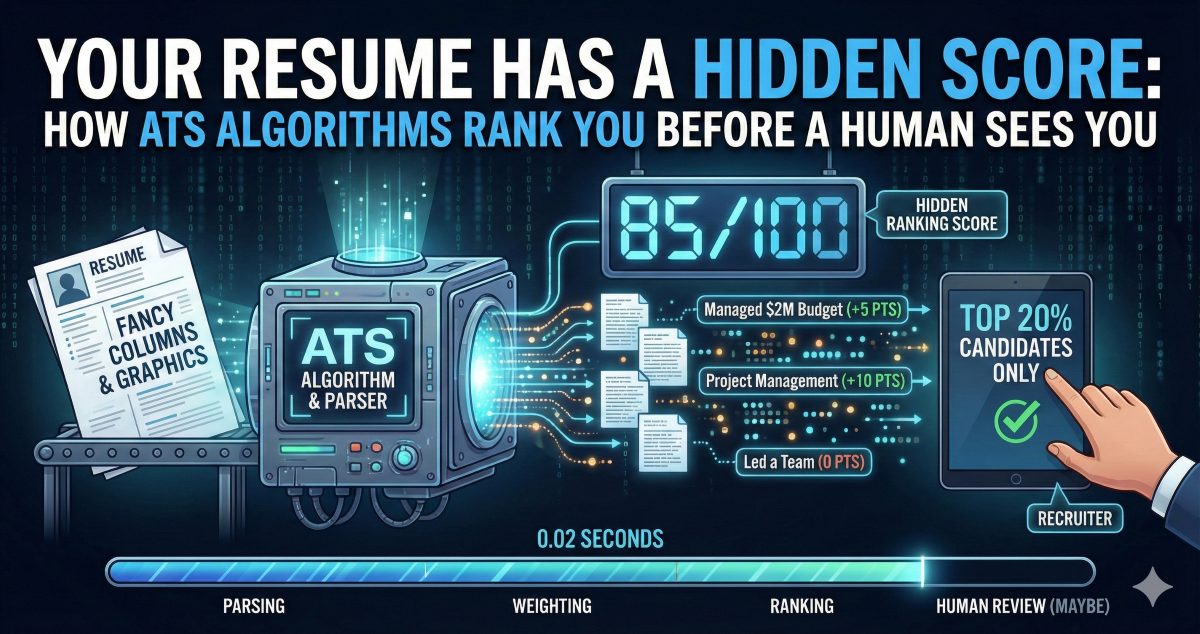
Key Takeaways
- The 6-Second Myth: Recruiters don’t see your resume first; an algorithm ranks it in 0.02 seconds.
- Parsing Errors: Fancy columns and graphic elements turn your experience into unreadable gibberish.
- Weighted Keywords: Generic verbs score zero points. Hard skills drive your ranking.
Stop obsessing over your font choice. Ignore the “aesthetic” advice from graphic designers who haven’t applied for a corporate job in a decade. While you are worrying about margins, a machine is stripping your document down to raw text and assigning you a number.
If that number isn’t in the top 20% of the applicant pool, you are invisible. You don’t exist.
Most candidates operate under the delusion that a human reviews every application. They don’t. The Applicant Tracking System (ATS) acts as a ruthless gatekeeper. It doesn’t care about your potential. It cares about data alignment. Here is how the math actually works against you.
1. Parsing vs. Ranking: The Destruction of Formatting
Before an ATS ranks you, it must read you. This process is called parsing. The system converts your PDF or Word doc into a plain text file or a JSON data structure. This is where 50% of qualified candidates fail immediately.
The parser reads left-to-right, top-to-bottom. If you use a two-column layout to save space, the parser often reads across the columns, merging two distinct sentences into nonsense.
Pro Tip: Never use text boxes, tables, or columns. If the text isn’t selectable in a straight line, the robot can’t read it. Stick to a standard, single-column hierarchy.
2. The Keyword Weighting System
Once the text is parsed, the scoring begins. The ATS compares your raw data against the job description using semantic analysis. But not all words are created equal.
This is a weighted system. Specific hard skills carry high point values. Soft skills and generic fluff carry zero.
| Resume Term | Estimated ATS Score | Why? |
|---|---|---|
| “Led a team” | 0 Points | Subjective, unmeasurable. |
| “Managed $2M Budget” | 5 Points | Quantifiable metric. |
| “Project Management” | 10 Points | Direct match to job title taxonomy. |
🚀 Bonus Tool: Keyword Gap Analyst
Stop guessing your rank. Compare your resume against the job description to get your instant match score.
⚡ Keyword Gap Analyst
3. The “Knockout” Questions
While keyword scoring determines your rank, “knockout” questions determine your survival. These are binary filters. If your data doesn’t match the required field exactly, the algorithm auto-rejects you. No human will ever open your file.
Common knockouts include:
- Visa Sponsorship: Checking “Yes” when the employer set the filter to “No” is an instant rejection.
- Years of Experience: If the role requires 5 years and your parsed data shows 4.5, you are filtered out.
- Location Radius: Algorithms often prioritize candidates within a specific zip code radius to minimize relocation costs.
Stop Guessing Your Rank
Sending a resume without auditing it first is strategic suicide. You are hoping for the best while the algorithm is calculating the worst. Don’t let a parsing error or a missing keyword cost you an interview.
Audit your resume. See the score. Fix the data. Then apply.