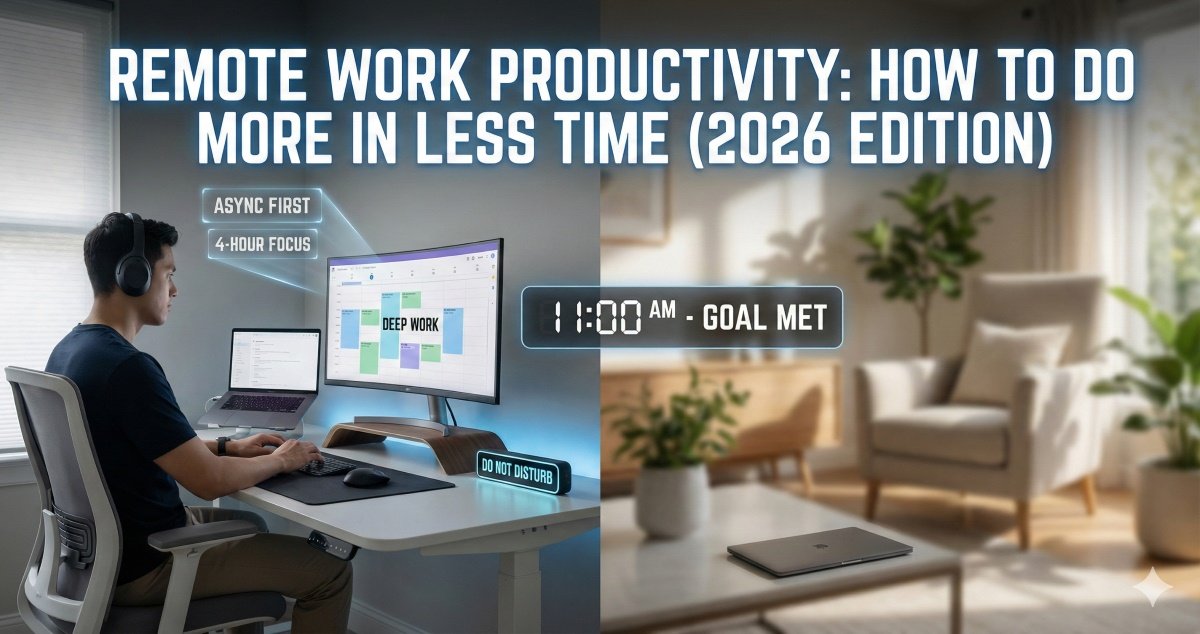
We’ve all been there. You sit down at 9 AM with a full cup of coffee and a plan to conquer the world. By 11 AM,
you’re deep in a Slack debate about the new logo, your laundry is calling your name, and you’ve accomplished
exactly… nothing.
Remote work was supposed to be the freedom dream. But for many, it’s become a blur of “always-on” anxiety and blurred
boundaries. The good news? Productivity isn’t about working harder. It’s about designing a system that protecting your
focus like a fortress.
Key Takeaways
- Asynchronous First: Stop treating Slack like a live conversation.
- Deep Work Blocks: Why 4 hours of focused work beats 8 hours of distracted work.
- Physical Boundaries: How your environment dictates your output.
1. The “Asynchronous-First” Mindset
The biggest productivity killer in remote work is the expectation of immediate response. If you are constantly
monitoring Slack or Teams, you are never doing deep work. You are just managing interruptions.
Shift to an asynchronous mindset. Batch your communication. Check messages at 10 AM, 1 PM, and 4 PM. If it’s a true
emergency, they will call you. Spoiler alert: It’s rarely an emergency.
💡 Pro Tip: Set your Slack status to “Deep Work – Checking messages at [Time]” to manage
expectations automatically.
2. Design Your “On” and “Off” Triggers
In an office, the commute is the trigger. It tells your brain “work is starting” or “work is ending.” At home, that
transition is gone. You need to manufacture it.
Create a startup ritual. Maybe it’s putting on shoes (yes, even at home) or brewing a specific tea. Create a shutdown
ritual, like closing your laptop and physically putting it in a drawer. These signals help your brain switch modes
and prevent burnout.
💰 Reality Check: Virtual vs. Commute
Before you consider going back to the office for a “higher salary,” use this calculator. It reveals your True Hourly Wage by treating your commute as unpaid work hours.
💸 Offer Reality Check
3. The 4-Hour Focus Rule
Standard 8-hour workdays are a relic of the industrial revolution. In knowledge work, you only have about 4 hours of
elite cognitive energy per day. Use them wisely.
Identify your “chronotype.” Are you a morning lark or a night owl? Schedule your hardest tasks during your peak
energy window. Defend that time aggressively. Use the rest of the day for admin, meetings, and low-energy tasks.
Is Your Resume Working Remotely?
Don’t let a bad resume block your remote career. Our
AI-driven Resume Auditor ensures your skills shine for remote-first employers.
4. Single-Tasking is a Superpower
Multitasking is a myth. You are just task-switching rapidly, and every switch costs you cognitive fuel. It’s called
“context switching,” and it lowers your IQ by up to 10 points while you do it.
Close your tabs. All of them. Keep only the one you need open. Use a “parking lot” notepad next to you. When a random
thought pops up (e.g., “I need to buy cat food”), write it down and get back to work. Deal with the parking lot
later.
5. Optimize Your Physical Space
Your environment dictates your behavior. If you work from your couch, your brain associates that space with
relaxation (or Netflix). Efficiency dies there.
You don’t need a dedicated office, but you need a dedicated “zone.” It could be a specific corner of the dining
table. Ensure your lighting is good (video calls matter), your chair supports your back, and your desk is
clutter-free. A messy desk is visual noise that drails focus.
Frequently Asked Questions
How do I stay motivated working from home?
Focus on “output” rather than “hours.” Set 3 clear goals for the day. When you finish them, allow yourself to stop.
The reward of finishing is better motivation than watching a clock.
What are the best tools for remote productivity?
Keep it simple. A good task manager (like Todoist or Notion), a calendar protector (like Clockwise), and a
distraction blocker (like Freedom) are usually all you need.
How do I separate work from life?
Physical boundaries are key. If possible, don’t work in your bedroom. If you must, hide your equipment at the end of
the day. Out of sight, out of mind.
Is remote work bad for career growth?
Not if you are proactive. You must “work out loud.” Share your wins, document your processes, and over-communicate
your progress. In remote work, visibility is your responsibility.
How do I deal with loneliness?
Schedule social interactions that are not work-related. Virtual coffee chats, co-working sessions, or local meetups.
Don’t rely solely on your team for social connection. Don’t rely solely on your team for social connection.