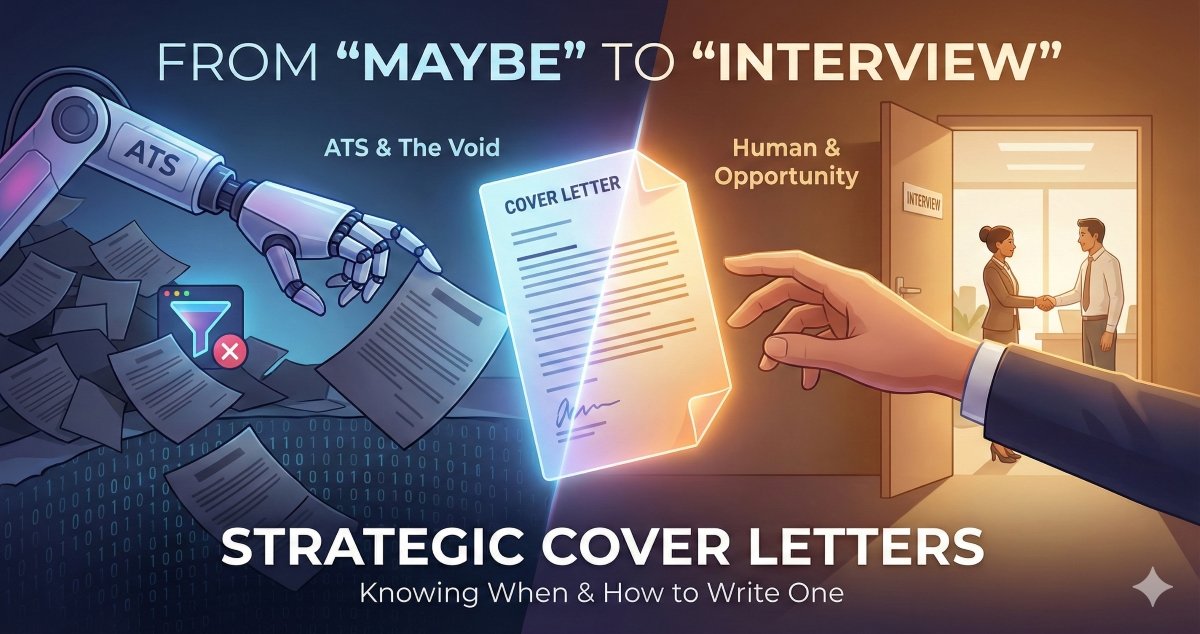
Let’s be honest: most cover letters are never read.
If your application goes through an ATS, there’s a 70% chance your cover letter won’t even be parsed. And if it does get through? The recruiter might spend 6 seconds skimming it.
So why write one at all?
Because in the right situations, a well-crafted cover letter can be the difference between “maybe” and “interview.” The key is knowing when to write one and how to make it count.
Key Takeaways
- ATS Doesn’t Care: Most ATS systems don’t parse or rank cover letters
- Humans Might: If your resume passes the ATS, a human may read your cover letter
- Strategic Use: Cover letters work best for career changes, employment gaps, or highly competitive roles
When to Write a Cover Letter
✅ Write a Cover Letter If:
- The Job Posting Requires It – If it says “required,” don’t skip it
- You’re Changing Careers – Explain why you’re pivoting and how your skills transfer
- You Have an Employment Gap – Address it proactively and positively
- You’re Applying to a Small Company – Smaller companies often read cover letters
- You Have a Referral – Mention the person who referred you in the opening
- The Role is Highly Competitive – Stand out with a compelling narrative
❌ Skip the Cover Letter If:
- It’s Optional and You’re Applying to a Large Company – Focus energy on resume optimization
- You’re Applying Through a Job Board – Most ATS systems don’t parse cover letters well
- Your Resume Tells the Whole Story – If you’re a perfect match, the resume is enough
- You’re Short on Time – Better to apply to 5 jobs with great resumes than 1 with a mediocre cover letter
How ATS Systems Handle Cover Letters
Here’s the truth about ATS and cover letters:
What ATS Does:
- Stores the cover letter as an attachment
- May extract basic text for keyword matching
- Doesn’t rank or score cover letters like resumes
What ATS Doesn’t Do:
- Parse cover letter formatting
- Weight cover letter keywords as heavily as resume keywords
- Guarantee a human will read it
📚 Key Insight
Your resume is what gets you past the ATS. The cover letter is for the human who reviews your application afterward.
The 3-Paragraph Cover Letter Formula
If you’re writing a cover letter, keep it to 3 paragraphs and under 300 words.
Paragraph 1: The Hook (2-3 sentences)
- State the position you’re applying for
- Mention how you found it (especially if referred)
- Lead with your strongest qualification
Example:
“I’m applying for the Senior Product Manager role at [Company]. As a Product Manager with 7 years of experience launching SaaS products that generated $50M+ in revenue, I’m excited by [Company’s] mission to [specific company goal].”
Paragraph 2: The Value Proposition (4-5 sentences)
- Highlight 2-3 specific achievements that match the job requirements
- Use numbers and metrics
- Connect your experience to their needs
Example:
“In my current role at [Company], I led the development of [product] which increased user engagement by 45% and reduced churn by 30%. I specialize in [skill from job posting], [skill from job posting], and [skill from job posting]—exactly what you’re seeking for this role. My experience with [specific tool/methodology they mentioned] would allow me to contribute immediately.”
Paragraph 3: The Close (2 sentences)
- Express enthusiasm
- Call to action
Example:
“I’m excited about the opportunity to bring my product strategy expertise to [Company] and contribute to [specific goal]. I’d welcome the chance to discuss how my background aligns with your needs.”
Cover Letter Mistakes That Kill Your Chances
1. Generic Templates
❌ “I am writing to express my interest in the position…”
✅ “As a data scientist who increased revenue by $2M through predictive modeling…”
2. Repeating Your Resume
Your cover letter should complement your resume, not duplicate it. Add context, not repetition.
3. Focusing on What You Want
❌ “This role would be a great opportunity for my career growth…”
✅ “My experience scaling e-commerce platforms would help [Company] achieve its Q2 revenue goals…”
4. Being Too Long
If it’s more than one page or 300 words, cut it. Recruiters won’t read it.
5. Typos and Errors
One typo can disqualify you. Proofread 3 times and use Grammarly.
Advanced Cover Letter Tactics
Tactic #1: The “Problem-Solution” Approach
Research the company’s challenges and position yourself as the solution:
“I noticed [Company] recently launched [product]. Having led similar launches at [Previous Company], I understand the challenge of [specific problem]. My approach to [solution] resulted in [metric], and I’d love to bring that expertise to your team.”
Tactic #2: The “Referral Name-Drop”
If someone referred you, lead with it:
“[Name], your [title] at [Company], suggested I reach out about the [role]. After learning about [specific project], I’m convinced my background in [skill] would be a strong fit.”
Tactic #3: The “Passion + Proof” Combo
Show genuine interest backed by evidence:
“As a long-time user of [Company’s product], I’ve been impressed by [specific feature]. My experience building similar features at [Previous Company]—which drove [metric]—would allow me to contribute to [Company’s] product roadmap immediately.”
Cover Letter Formatting for ATS
Even though ATS doesn’t heavily parse cover letters, follow these rules:
- Use .docx or PDF format (match your resume format)
- Standard fonts only (Arial, Calibri, Times New Roman)
- No tables, columns, or graphics
- Include your contact info at the top (just like your resume header)
- Use standard margins (1 inch all around)
⚠️ Important
Remember, formatting mistakes that hurt your resume can hurt your cover letter too.
Frequently Asked Questions
Do I need a cover letter if the application doesn’t ask for one?
No. If it’s optional and you’re applying to a large company through an ATS, focus your energy on optimizing your resume instead.
Should I address my cover letter to a specific person?
If you can easily find the hiring manager’s name (LinkedIn, company website), use it. Otherwise, “Dear Hiring Manager” is fine. Don’t waste time hunting for a name.
Can I use the same cover letter for multiple applications?
No. Each cover letter should be customized to the specific role and company. At minimum, change the company name, role title, and 1-2 specific details about why you’re interested.
How do I explain an employment gap in a cover letter?
Be brief and positive. “After [reason for gap], I’m excited to return to [field] and bring my experience in [skills] to [Company].” Don’t over-explain or apologize.
Should I mention salary requirements in my cover letter?
Only if the job posting specifically requests it. Otherwise, save salary discussions for later in the process.