Key Takeaways
- The Reality: ATS algorithms prioritize “Hard Skills” (Nouns) over “Power Words” (Verbs).
- The Mechanism: An Applicant Tracking System is a matching engine, not a human reader.
- The Solution: You must balance human readability with robotic keyword optimization.
Career coaches have been repeating the same mantra for twenty years: “Start every bullet point with a power verb.”
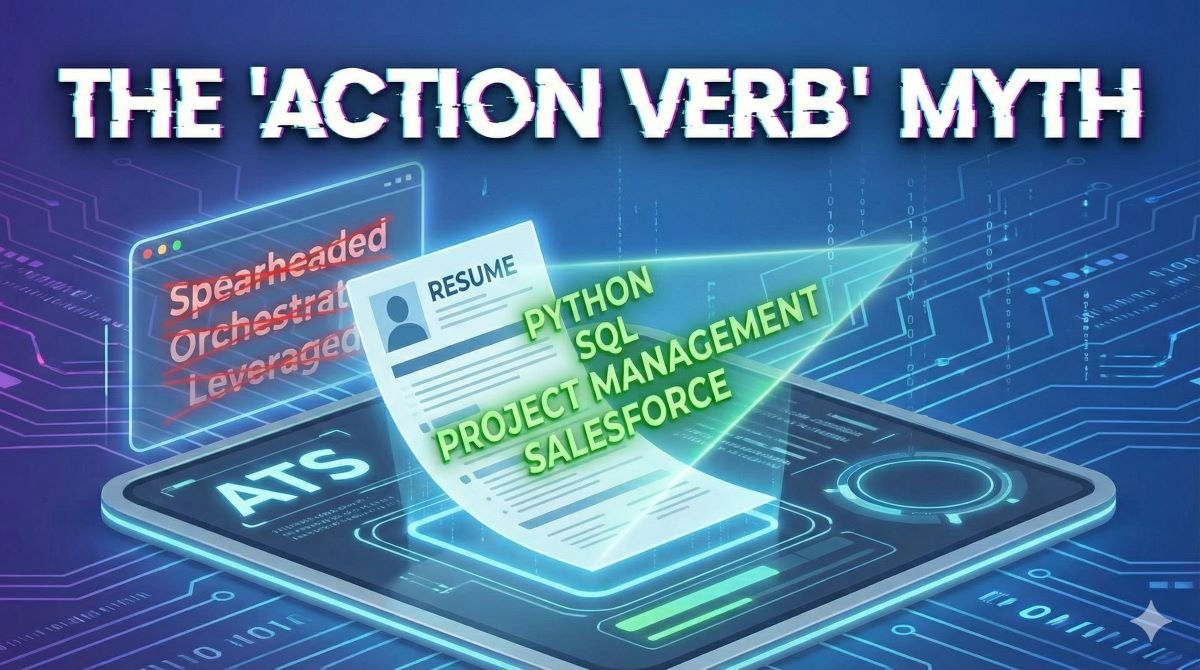
You know the drill. Spearheaded. Orchestrated. Leveraged.
While these words sound impressive to a human hiring manager, they are practically invisible to the machine standing between you and the interview. This is the uncomfortable truth about Resume Writing in the modern era: The robot doesn’t care how passionately you did the work. It only cares about the tools you used to do it.
The Logic: Nouns vs. Verbs in an ATS Resume
To understand why verbs fail, you have to understand how the software thinks. An Applicant Tracking System (ATS) is essentially a giant “Ctrl+F” search engine on steroids.
Recruiters input search queries based on hard requirements. These are almost exclusively nouns. A recruiter looks for “Python,” “Project Management,” “Salesforce,” or “GAAP.” They rarely, if ever, search for candidates who “empowered” or “synergized.”
If your resume is packed with fluff verbs but misses the specific Resume Keywords defined in the job description, your alignment score drops. You could be the most “innovative” candidate in the pile, but without the noun “Figma,” you do not exist to the algorithm.

Get the Tool: The Resume Auditor
Streamline your job application process with our powerful AI-driven Resume Auditor. Analyze, optimize, and beat the ATS with ease!
The Noun Hunt: Identifying Hard Keywords
Keyword Optimization isn’t about guessing; it is about data extraction. The job description tells you exactly what the ATS wants to see. Your job is to find the nouns hiding in plain sight.
Look for three categories of nouns:
- Hard Skills: Data Analysis, SEO, Contract Negotiation.
- Tools & Software:1 Jira, HubSpot, Adobe Creative Suite, Excel.
- Credentials: MBA, PMP, CPA, Google Analytics Certified.
The Semantic Comparison
| The “Action Verb” Approach (Weak) | The “Noun-First” Approach (Strong) |
|---|---|
| Efficiently managed databases to improve speed. | Optimized SQL queries to reduce latency by 40%. |
| Created designs for marketing materials. | Designed vector assets in Adobe Illustrator for Q4 Campaigns. |
| Responsible for leading the sales team. | Managed a B2B Sales Pipeline using Salesforce CRM. |
🚀 Bonus Tool: Google XYZ Bullet Builder
Don’t guess. Use this tool to structure your bullet points into the exact format Google recruiters look for.
🎯 Google XYZ Bullet Builder
The Fix: Audit Your Profile
We aren’t suggesting you write like a robot. A human will eventually read your resume if you pass the initial scan. The strategy is to retain the action verbs for flow, but anchor them with heavy, search-friendly nouns.
Don’t just say you “wrote code.” Say you “Developed scalable microservices using Java and Spring Boot.”
Conduct a Resume Audit today. Scan your top three target job descriptions. Highlight every noun. If those nouns aren’t in your document, no amount of “spearheading” will save you.